

7 Proven Mesh Belt Dryer Working Principle Checks
When food processors and chemical plants transition from batch tray ovens to high-volume manufacturing, non-uniform moisture and high labor costs become major challenges. The mesh belt dryer working principle provides continuous, multi-tiered thermal processing with precise independent zone temperature regulation. Backed by 20 years of equipment fabrication at Jiangsu Changshi Drying Technology Co., Ltd (JSCSTECH), our continuous belt systems maximize energy efficiency while preserving product integrity.

How does the mesh belt dryer working principle achieve uniform continuous moisture removal?
Raw material is uniformly dispersed onto a continuously moving stainless steel wire mesh belt by an automatic vibrating feeder. As the belt travels through the insulated drying tunnel, conditioned hot air penetrates vertically through the material bed from alternating directions. This direct convective heat exchange rapidly vaporizes surface and capillary moisture without mechanical agitation.
In multi-layer configurations, the material gently drops from the upper belt tier to the reverse-running lower tier at each turnaround. This automatic turnover exposes unevaporated inner surfaces to fresh thermal airflow, ensuring homogeneous moisture discharge. JSCSTECH calculates layer drop heights precisely to avoid particle breakage on fragile dried botanicals or extruded granules.
Why is multi-zone temperature and humidity profiling essential?
Drying kinetics vary dramatically across the initial heating, constant-rate drying, and falling-rate moisture diffusion stages. The entry zone requires elevated thermal input and rapid exhaust to carry away high volumes of evaporated surface water. Conversely, the final curing zones require lower temperatures and controlled dwell times to prevent thermal degradation or case hardening.
Each drying section in our design operates with dedicated circulation blowers, steam or gas heat exchangers, and exhaust dampers. This modular zoning allows plant operators to adjust thermal curves to suit diverse seasonal harvest moistures. Our custom engineering guarantees strict moisture tolerances across wide production throughput ranges.
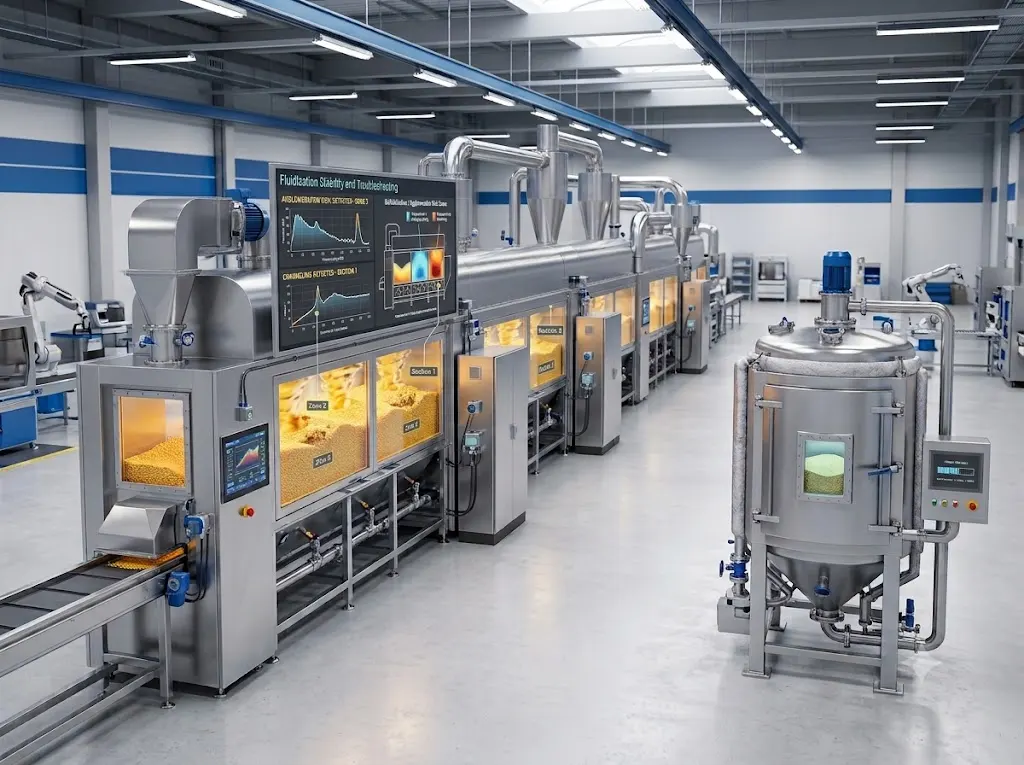
How do belt speed and bed depth parameters impact thermal efficiency?
Overloading bed thickness creates air channeling and leaves lower layers damp while top layers over-dry. Conversely, an excessively thin layer causes thermal bypass, wasting electrical fan power and heating fuel. We engineer adjustable bed levelers and VFD-governed belt drives to synchronize bed depth with hot air static pressure.
In our 10,000 square meter facility, drying tunnels are insulated with high-density rock wool enclosed in polished stainless paneling. Recirculating up to 70% of preheated dry air reduces boiler steam consumption by 15% to 25% compared to single-pass tunnels. This delivers substantial long-term operating cost savings for energy-intensive industrial drying plants.
What belt construction and tracking mechanisms ensure reliable 24/7 uptime?
Mesh belt distortion and tracking drift are common causes of unexpected shutdown in poorly engineered continuous dryers. Industrial belt options range from balanced spiral wire weaves to heavy-duty perforated stainless chain-plate links. Chain-driven edge guides eliminate lateral slippage under heavy wet feed loading conditions.
Automatic pneumatic belt tensioning cylinders maintain consistent drive friction despite thermal expansion at 150 degrees Celsius. Smooth internal guide rails and accessible side inspection doors enable rapid preventative maintenance checks. This robust mechanical construction ensures uninterrupted continuous production across demanding seasonal processing campaigns.
Mesh Belt Dryer Working Principle: Process Engineering Comparison
| Process Parameter | Single-Pass Belt Tunnel | Multi-Layer Continuous Belt (JSCSTECH) |
|---|---|---|
| Floor Space Footprint | Large longitudinal space required | Compact vertical footprint (3 to 7 tiers) |
| Material Turning Action | Static on single belt (no turning) | Automatic layer-to-layer cascade turnover |
| Airflow Directionality | Unidirectional cross-flow | Reversible through-circulation (up/down flow) |
| Thermal Energy Recycling | Often single-pass exhaust (<30% recovery) | Integrated zone recirculation (up to 70% recovery) |
| Output Moisture Uniformity | Moderate (requires manual leveling) | High precision (uniform batch discharge ±0.5%) |
Supplier Audit Checklist: 5 Documents to Request Before Signing a Purchase Order
- Material Drying Rate Curve Test Report establishing target evaporation capacity (kg H2O/hour).
- Thermal Mass and Energy Balance Calculation confirming heat source sizing and fuel consumption.
- Insulation Thermal Efficiency Audit and external wall surface temperature guarantee (<45°C).
- Belt Material Food Contact Certificate (FDA/EC 1935/2004) and tensile load strength data sheet.
- Factory Acceptance Test (FAT) Schedule with motor vibration and temperature uniformity validation.
Frequently Asked Questions
Q: What products are best suited for multi-layer mesh belt drying? Continuous mesh belt systems are ideal for sliced vegetables, traditional herbs, fruit pieces, feed pellets, catalysts, and extruded chemical briquettes. JSCSTECH configures belt mesh openings and speed to match product friability and drying kinetics. Request material drying curve testing before selecting belt length.
Q: How is airflow circulation controlled across different drying zones? Independent air circulation fans and heat exchangers allow each drying zone to maintain customized temperature and humidity profiles. We install adjustable air distribution louvers to prevent localized product over-drying. When auditing suppliers, inspect zone isolation damper specifications.
Q: How do you prevent delicate food products from sticking to stainless mesh belts? We utilize food-grade non-stick PTFE-coated stainless wire mesh or polished chain-plate belts with integrated release scrapers. Variable frequency belt drives ensure synchronized layer-to-layer transfer without physical product crushing. Request belt material food contact compliance certificates prior to purchase.
Review our specialized industrial drying equipment and study our rotary drum scraper dryer working principle guide for high-viscosity feeds. You can also consult our industrial dryer energy consumption optimization guide.
For comprehensive engineering research on continuous belt thermal processing, review the ScienceDirect continuous belt drying analysis. Contact Leta via WhatsApp: +86 137 7529 9712 with your hourly throughput and raw moisture data for a tailored multi-layer dryer proposal.
